
The honest answer is: possibly, but you cannot tell from a headline tax rate or a company setup quote.
For an Australian business owner, the useful comparison is not simply “Australia versus Dubai”. It is your present position versus a realistic first year in Dubai, followed by a normal recurring year. That comparison needs to include household cash flow, business effects, establishment costs and tax outcomes assessed from your circumstances.
This article provides general information, not personal tax, legal, financial, immigration or travel advice. Obtain advice from appropriately qualified professionals before acting.
At a glance
Key takeaways
- Compare your current Australian position, the first year in Dubai and a normal recurring year as three different financial pictures.
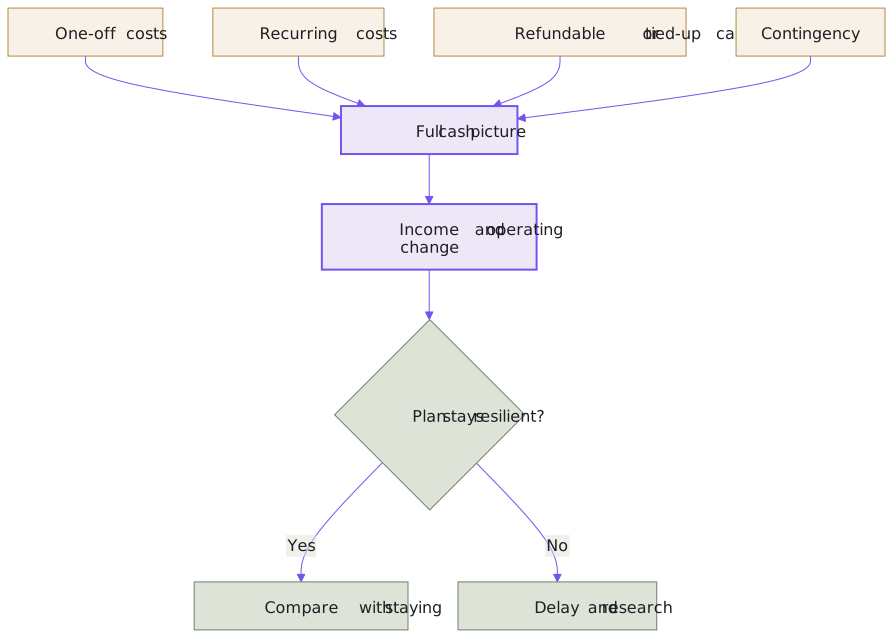
- Separate one-off expenses, recurring costs, refundable cash commitments and unknown amounts instead of relying on a package price.
- Use conservative scenarios and keep any tax outcome as an adviser-tested input rather than the assumption that makes the move work.
- Test liquidity, assets, contingencies and reversal costs as well as the annual household and business budget.
Start with three different numbers
Build three totals rather than one:
- Cash required before and during the move. Include professional advice, applications, travel, temporary accommodation, removals, setup expenses and refundable deposits.
- First-year net position. Compare income and costs, including one-off expenses and disruption to business income. Do not treat refundable deposits as permanent costs.
- Normal annual position. Compare income, business costs and household spending once establishment expenses have ended.
This separation matters because a move that appears less expensive in an ordinary year can still demand substantial cash at the beginning.
Australian departure and overseas establishment are separate but connected workstreams. Planning may need to cover personal circumstances, the business and its assets, destination establishment, responsibilities and handoffs.
The cash-flow worksheet
Use this proposed worksheet with written quotes and your own current figures. Record both the Australia option and the Dubai option for the same period. Keep separate business and household schedules. For the combined comparison, remove transfers between them, such as owner drawings, so the same cash is not counted twice. If an income figure is already profit after operating expenses, do not subtract those expenses again. Ask your accountant to confirm the basis you use.
| Item | Stay in Australia | Dubai: first year | Dubai: later year | Evidence or owner |
|---|---|---|---|---|
| Income after disruption, excluding transfers between business and household | Contracts, forecast | |||
| Housing and associated charges | Current lease or written quote | |||
| Utilities and household services | Provider information | |||
| Health cover and medical costs | Written quote | |||
| Schooling or childcare | Written quote | |||
| Flights and visits to Australia | Current itinerary estimate | |||
| Visa and establishment expenses | Provider or authority | |||
| Business setup and annual renewals | Itemised quote | |||
| Other business operating costs, if not already deducted from income | Accounts, written estimates | |||
| Professional tax and legal advice | Adviser scope | |||
| Moving, temporary housing and furnishing | Written estimates | |||
| Refundable deposits | Not applicable | Terms and refund conditions | ||
| Tax provision | Qualified adviser | |||
| Contingency | Your assumption |
For every line, mark it as one-off, recurring, refundable or uncertain. Also record whether the figure includes tax, who is responsible for it and what earlier decision it depends on.
Dubai’s official electricity and water move-in information distinguishes a refundable residential security deposit from activation charges. DEWA: electricity and water move-in service That is a small example of a broader budgeting rule: cash tied up is not the same as money permanently spent, but you still need the cash available.
For housing, the Dubai Land Department rental index uses contract and property-specific details. Dubai Land Department: rental index Use it as a reference point, then obtain current written quotes for homes that meet your actual location, size and timing requirements.
A hypothetical example
Assume a business owner estimates the following, purely to test the method:
- Staying in Australia produces annual household and business outgoings of 180,000 Australian dollars.
- A normal Dubai year produces recurring outgoings of 150,000 Australian dollars.
- The move requires 35,000 Australian dollars of one-off expenditure.
- A further 15,000 Australian dollars is tied up in refundable deposits.
- Business disruption reduces first-year income by 20,000 Australian dollars.
Assume, solely for this illustration, that all other income and tax effects are unchanged and both sets of outgoings use the same basis. The recurring difference is 30,000 Australian dollars a year. Subtract the one-off expenditure of 35,000 and lost income of 20,000: the first-year position is 25,000 Australian dollars worse than staying, before refundable deposits. The additional 15,000 held in deposits makes first-year available cash 40,000 Australian dollars lower. Deposits may be returned under their terms; they are not an extra permanent annual expense.
This is not a market estimate or a suggested outcome. Replace every number with written evidence and assumptions suited to your circumstances. Keep refundable deposits visible as a cash requirement without double counting them as permanent annual expenses.
Then run at least three versions:
- Expected: the figures you consider most likely.
- Pressure: lower income, higher housing or another renewal assumption.
- Delay: the move or business transition takes longer than planned.
If the decision works only in the most optimistic version, treat that as a warning: test the assumptions, downside exposure and available buffer before committing.
Do not use a visa as a tax answer
One Dubai route is a renewable one-year virtual-work residence permit for people working remotely for an overseas organisation, subject to stated requirements. GDRFA Dubai: virtual work residence permit It is only one immigration route. Eligibility for a permit does not, by itself, determine your Australian tax position or authorise every business activity.
Leaving Australia does not automatically resolve Australian tax residency. Relevant circumstances can include presence, intentions, behaviour, family and business ties, assets and living arrangements; no single factor decides every case. ATO Taxation Ruling TR 2023/1: residency tests for individuals
Nor should Dubai be modelled as universally tax-free. UAE rules can bring an individual conducting business within corporate tax, while treating wages differently from business income. UAE Federal Tax Authority: natural-person corporate tax Your Australian and UAE positions, business structure and income character need individual assessment.
In the worksheet, keep tax as an adviser-assessed line until appropriately qualified advisers have reviewed the facts. Do not insert an assumed saving simply because the destination has a different tax system.
Test the balance sheet as well as the annual budget
The Australian Exit Guide brings asset ownership, valuations, liquidity and destination-side treatment into departure planning, rather than considering the Australian side in isolation.
A lower annual household budget can be attractive while the move still requires more cash than you can comfortably make available. An asset’s estimated value is not the same as money available to pay a bill.
Alongside the cash-flow worksheet, prepare a short asset schedule for your advisers:
| Record | Question to resolve |
|---|---|
| Owner and asset | Is it held personally or through an entity, and who needs to assess it? |
| Available information | What ownership, cost and valuation records already exist? |
| Liquidity | If funds were needed, how could they be obtained without assuming an immediate sale? |
| Departure and arrival assumptions | What needs to be modelled on each side, including any interaction between them? |
| Payment timing | Which amounts, if any, could become payable before the expected annual benefit arrives? |
This schedule does not establish that a tax charge arises or recommend selling or restructuring an asset. It makes unanswered modelling questions visible before they are buried inside a relocation budget.
Keep business performance in the comparison too. Ask whether customer service, sales, decision-making or staff support would weaken during the move. Record income disruption separately from expenses, and avoid counting a business cost again if it has already been deducted in the income figure.
Our practical test is whether the proposed move works through the transition as well as in an established year. If it needs an unverified tax assumption, an immediate asset sale or uninterrupted revenue to balance, investigate that dependency before treating the move as financially attractive.
When staying or delaying may be the better decision
Consider staying in Australia or delaying the move if:
- your immigration route has not been confirmed;
- the plan depends on an unassessed tax outcome;
- housing, health cover or schooling figures are still guesses;
- the business cannot absorb transition disruption;
- family priorities have been treated as budget lines rather than decision criteria;
- the first-year cash requirement would leave too little resilience; or
- different advisers or providers have not made their responsibilities and exclusions clear.
Travel conditions also belong in the decision. As checked on 19 September 2026, Australia advises reconsidering UAE travel. Australian Government Smartraveller: UAE advice Check the live advisory before acting because conditions can change quickly.
The decision rule
Do not ask, “Is Dubai cheaper?” Ask:
After one-off costs, refundable cash commitments, recurring expenses, business effects and personally assessed tax outcomes, does moving improve the things that matter enough to justify the disruption and risk?
If you cannot fill the worksheet with defensible figures, the next step is research, not commitment. The Australian Exit Guide can help you understand the foundations of planning an overseas move. Australian Exit Guide For conclusions about your own tax, legal, immigration or financial position, discuss your circumstances with appropriately qualified advisers.
Important: This article is general information only and does not constitute legal, tax, financial, investment or immigration advice. Rules and programmes can change. Obtain advice from appropriately qualified professionals who understand your facts and the relevant jurisdictions before acting.