

The short answer: Dubai may suit you if you have a workable residence and business route, your household accepts the daily-life trade-offs, and the move still makes financial sense after full costs and Australian implications. If any one of those conditions fails, staying in Australia or delaying the move may be the better decision.
On 19 September 2026, Australian advice was to reconsider UAE travel. Australian Government Smartraveller: UAE advice Check the live advisory before making travel or relocation decisions.
This is general information, not personal tax, legal, immigration or financial advice. Your position depends on your facts and requires appropriately qualified advice.
At a glance
Key takeaways
- Dubai is worth considering only if you have a lawful residence and business route that fits what you actually intend to do.
- Test an ordinary working and family week rather than judging the move from an ideal visit or best-case routine.
- Model the move using full costs and conservative assumptions without relying on an optimistic tax outcome.
- Delay or reconsider the move when a critical permission, household requirement, business dependency or financial assumption remains unresolved.
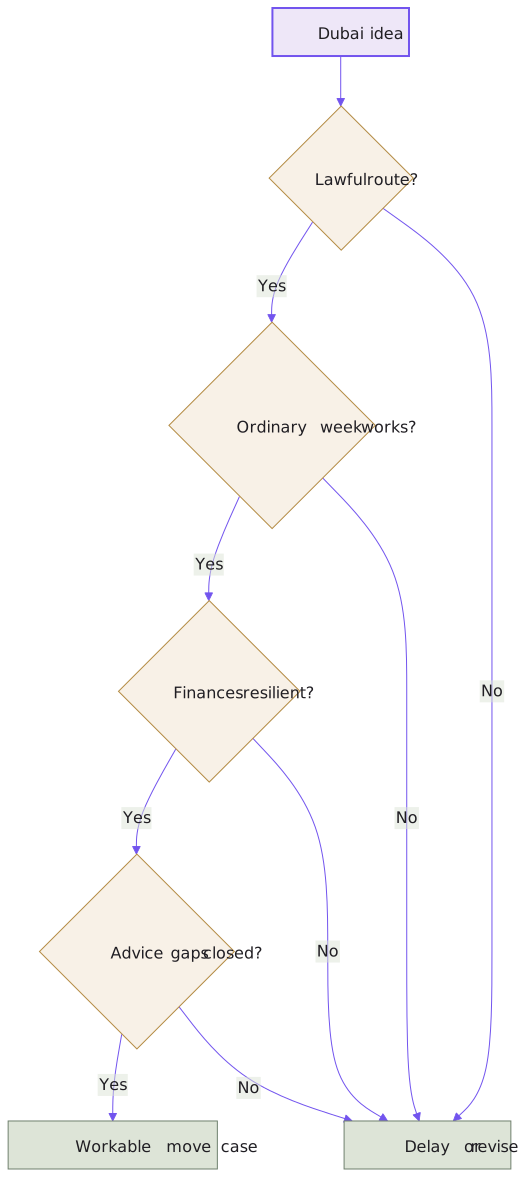
1. Do you have a lawful, workable route?
Start with what you need permission to do, not with a company package or a headline tax claim.
Dubai offers a renewable one-year virtual-work residence permit for eligible people working remotely for an organisation outside the UAE. GDRFA Dubai: virtual work residence permit That narrow example does not establish that a self-employed owner, their company or their family qualifies. Nor does it confirm permission for every proposed business activity.
Write down:
- Who will earn the income: you personally, an Australian entity, a UAE entity or another structure?
- Where will customers, staff and management activity be located?
- What work will you actually perform while in Dubai?
- Which residence and business permissions apply to each person and entity?
- What evidence and renewals will be required?
A visa answers an immigration question. It does not, by itself, establish your tax residence or end Australian tax residence. These issues must be assessed separately rather than treated as consequences of buying a setup package. ATO: your tax residency
The UAE should not be described as universally tax-free. Individuals conducting business can come within UAE corporate tax rules, while wages are treated differently from business income. UAE Federal Tax Authority: natural-person corporate tax Your Australian position and any UAE obligations need assessment against your own activities, entities, assets and connections.
2. Test an ordinary week, not an ideal week
The Australian Exit Guide evaluates a destination partly through the ordinary life a person can establish there and the travel pattern they intend to maintain.
For Dubai, turn that principle into a realistic weekly calendar. Put in client calls, school or care commitments, work that still needs your presence in Australia, household tasks and time with family. Add the return visits you genuinely expect to make.
Then test three questions:
- Which commitments can happen from the proposed base without relying on an unrealistic routine?
- Which depend on another person changing their plans or taking over work?
- Would the arrangement still appeal if the financial benefit were smaller than hoped?
For a hypothetical owner whose preferred routine includes frequent trips back for operational decisions, “I can work remotely” leaves an important question open: who runs those parts of the business when the owner is away? Resolve that operating question before treating the destination as a good fit.
The calendar is a suitability exercise, not evidence that you qualify for a visa or have changed tax residence. Its purpose is to expose a plan that works only in a best-case week.
Use current, property-specific evidence when testing the housing budget. Dubai’s official rental index uses property and contract details; it is not a quote for your next home. Dubai Land Department: rental index Obtain written quotes matching the location, property and timing you are considering.
Also separate refundable cash commitments from expenses. Dubai’s electricity and water move-in process distinguishes a residential security deposit from activation charges. DEWA: electricity and water move-in service Keep that distinction visible in the household budget.
3. Are the finances resilient without an optimistic tax outcome?
Do not ask only, “Will I pay less tax?” Ask whether the move works after establishment costs, housing, insurance, travel, professional advice, renewals, business disruption and a contingency allowance.
Build three scenarios:
- Stay in Australia for the next 12 months.
- Move to Dubai on conservative assumptions.
- Delay while resolving one or two major uncertainties.
Keep tax outcomes as an adviser-tested input, not the number that makes the spreadsheet work. If the move fails under a conservative scenario, or depends on revenue arriving immediately, it is not yet financially resilient.
Australian departure and overseas establishment are separate but connected workstreams involving personal circumstances, business, assets, responsibilities and handoffs. A provider who can implement one part of the move may not be responsible for answering every Australian question. Ask who owns each issue before you pay.
The Dubai suitability scorecard
This is a proposed decision aid, not a legal test. Score each statement from 0 to 2: 0 means unresolved or unacceptable, 1 means possible but uncertain, and 2 means supported by evidence you are comfortable relying on.
| Test | Question | Score 0–2 | Evidence to collect |
|---|---|---|---|
| Residence route | Have we identified a plausible route for every relocating family member? | Written eligibility assessment and requirements | |
| Business permission | Can the proposed work and structure operate lawfully? | Written scope from the relevant specialist or authority | |
| Australian position | Have our residence, entity, asset and departure questions been assessed? | Advice based on our facts | |
| Household fit | Does the move work for family, care, schooling and relationships? | Each household member’s non-negotiables | |
| Housing | Can we afford a suitable home using current written evidence? | Property-specific quotes and move-in terms | |
| Total cash | Have we separated deposits, one-off costs, recurring costs and contingencies? | A 12-month cash-flow comparison | |
| Business resilience | Can the business tolerate disruption, time-zone effects and weaker revenue? | Conservative operating scenario | |
| Travel context | Have we checked current Australian travel advice? | Dated review of the live advisory |
A high total should not override a zero on a critical issue. If residence eligibility, lawful business activity, household consent or financial resilience is unresolved, pause and investigate it directly.
Who should delay or reconsider Dubai?
Delay if your proposed route has not been checked, your Australian position is being inferred from a visa, or the budget relies on unspecified savings. Reconsider if the household trade-offs are unacceptable, the business depends heavily on being physically close to Australian customers, or another destination better fits your actual constraints.
Staying in Australia is a valid decision. So is delaying until the evidence improves. Dubai should win the comparison because it fits your business and life, not because you started with it as the answer.
If you need the foundations before seeking personal advice, explore the Australian Exit Guide. Australian Exit Guide For conclusions about your circumstances, speak with appropriately qualified Australian and destination-specific advisers.
Important: This article is general information only and does not constitute legal, tax, financial, investment or immigration advice. Rules and programmes can change. Obtain advice from appropriately qualified professionals who understand your facts and the relevant jurisdictions before acting.