

The best destination is not the one with the strongest headline. It is the one that your business and family can legally use, practically sustain and still prefer after the full costs and consequences are clear.
For many Australian business owners, the real shortlist might be:
- stay in Australia for now
- investigate Dubai
- investigate another destination, such as Singapore
- delay the decision until a major dependency is resolved
Treat these as options to test, not rankings. Start with feasibility, then compare business fit, family fit, total cost and timing.
This article provides general information, not personal legal, tax, immigration or financial advice. The outcome depends on your circumstances and requires appropriately qualified advice.
At a glance
Key takeaways
- Compare only destinations that offer a workable residence route and permit the business activity you actually intend to conduct.
- Use the same business, family, cost and evidence criteria for every destination instead of comparing headlines or generic rankings.
- Keep immigration permission, Australian tax residency and destination tax treatment as separate questions requiring separate evidence.
- Treat delay as a valid outcome when eligibility, family fit, full costs or material advice questions remain unresolved.
1. Test whether each option is feasible
Do this before comparing weather, housing or lifestyle.
Ask four basic questions:
- Is there a residence route that fits what I actually do?
- Can I conduct my intended business activities under the relevant rules?
- Can my partner and dependants obtain suitable status?
- Would the arrangement work for the period we expect to stay?
Do not assume that being a business owner makes every entrepreneur or remote-work route available.
Dubai offers a renewable one-year virtual-work residence permit for qualifying people working remotely for an organisation outside the UAE. GDRFA Dubai: virtual work residence permit That is one example, not proof that it suits a self-employed owner, their company or their family.
Singapore’s EntrePass is aimed at eligible foreign entrepreneurs operating venture-backed or innovative-technology businesses; it is not a general pass for every owner. Singapore Ministry of Manpower: EntrePass Other Singapore routes may exist, so an unsuitable EntrePass does not by itself rule Singapore out.
If you stay in Australia, establishing a foreign residence route is not part of that option. Staying or delaying may therefore be sensible while you investigate eligibility elsewhere.
2. Separate immigration from tax residence
A residence visa answers an immigration question. It does not by itself establish tax residence, and becoming a foreign tax resident does not by itself end Australian tax residence. ATO: your tax residency
That distinction matters when comparing destinations. A place may look attractive on a company-formation page but produce a poor personal outcome once your Australian connections, business structure, assets and intended living pattern are considered.
Before treating any tax difference as a benefit, ask an appropriately qualified adviser:
- What facts would affect my Australian tax residence?
- How could the move affect my company, trusts, assets and income flows?
- Which conclusions depend on what I actually do after leaving?
- Which destination-specific advisers need to be involved?
Do not score a destination using headline tax rates alone.
3. Compare each destination against the same owner and business
Our guide’s destination framework considers the tax model, Australian connections, existing structures, ordinary life and future mobility alongside residence requirements.
A country’s headline rate cannot fill in that assessment. Start with one factual description of your household, income sources, assets and business. Use the same description for every shortlisted location; otherwise you may be comparing an optimistic version of one country with a realistic version of another.
Keep a comparison question beside each part of that description:
- Income: What is each receipt actually from, who receives it and where is the underlying work or activity? Ask the relevant advisers how each destination would treat it.
- Business: Which people, premises, customers and decisions would stay where they are? What operating changes would each destination require you to investigate?
- Structures and assets: What already exists, and what additional questions would it create in the destination?
- Daily life and mobility: Can you build the proposed routine there, including the travel you actually intend to do?
Record answers as confirmed, unresolved or dependent on a stated assumption. Do not award a destination a financial advantage while the relevant income or entity treatment is still unknown.
For example, two hypothetical owners with similar turnover might have very different operating models: one depends on Australian premises and staff, while the other performs most work personally online. That is a reason to ask different implementation questions, not a basis for announcing a country or tax outcome for either owner.
Choose the option that survives your facts. A destination’s reputation is only a starting point for research.
4. Include the family decision
A technically workable move can still be the wrong move.
Discuss the questions that are easy to postpone:
- Does a partner want the move, tolerate it or oppose it?
- What schooling, care or health arrangements must be maintained?
- How often would the family need to return to Australia?
- Which relationships and support networks would become harder to maintain?
- Is the intended move temporary, open-ended or genuinely permanent?
- What would cause the family to return?
These are not secondary lifestyle details. They affect cost, timing and whether the plan can last.
5. Compare the full cost, not a promotional package
Build a personal estimate for each option. Keep one-off costs separate from recurring costs and mark every uncertain figure.
Consider:
- professional advice in Australia and the destination
- visas, business establishment and renewals
- housing, deposits, utilities and insurance
- schooling, childcare and healthcare
- moving, storage and return travel
- changes to business overheads
- the value of time spent on administration
- contingency funds and the cost of reversing the move
Do not compare the cost of staying with only the advertised setup price overseas. Compare complete scenarios over the same period.
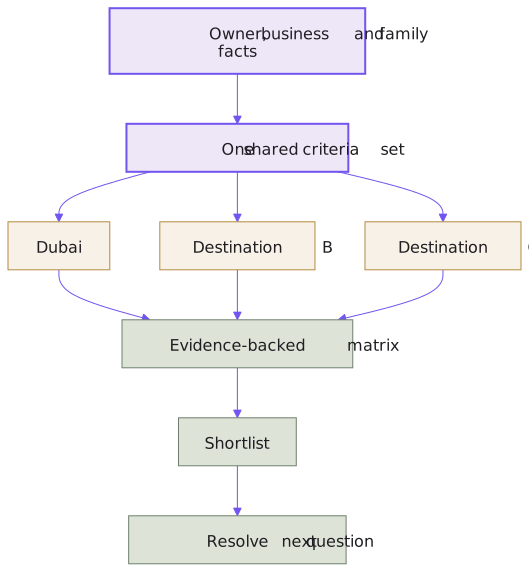
A shortlist decision matrix
Use this as a proposed worksheet. Replace the example weights with your own and score only after checking feasibility.
| Criterion | Your weight (1–5) | Stay in Australia | Dubai | Singapore | Evidence or unanswered question |
|---|---|---|---|---|---|
| Suitable residence route | 5 | Which route fits the owner and family? | |||
| Intended business activity permitted | 5 | Who confirms this? | |||
| Australian tax implications understood | 5 | Which facts remain unresolved? | |||
| Customer and operating fit | Would location help or hinder delivery? | ||||
| Family fit | Schooling, care, health and support needs? | ||||
| Full recurring cost | What has been omitted from estimates? | ||||
| One-off and reversal cost | What if the move lasts only one year? | ||||
| Timing and travel conditions | What must be true before committing? |
Use a simple score from 1 to 5, multiply it by your weight and record the reason. Do not let a high total override a failed feasibility question. A missing residence route, unsuitable business permission or unacceptable family constraint is a stop sign, not a low score to average away.
When to delay the choice
Delay can be a decision rather than indecision. Consider pausing if:
- you have not confirmed a workable residence route
- your Australian tax position depends on facts you have not gathered
- a partner or dependant has an unresolved requirement
- the business cannot yet operate without your Australian presence
- your cost comparison contains major blank spaces
- current travel conditions change the timing or risk
As checked 19 September 2026, Australia advises reconsidering UAE travel. Australian Government Smartraveller: UAE advice Check the live advisory before acting because travel advice can change quickly.
Choose the next question, not the winning country
Your first output should be a shortlist and an evidence gap list. It may show that Dubai deserves deeper investigation, that Singapore warrants research under a different residence route, or that staying in Australia is currently the strongest option.
Australian departure and overseas establishment are distinct but connected workstreams involving personal circumstances, business, assets, responsibilities and handoffs. Ask who advises on each issue, who implements the answer, what is excluded and who owns the follow-up.
If you need the foundations before seeking personal advice, explore the Australian Exit Guide. Australian Exit Guide For conclusions about your own tax, legal, immigration or financial position, discuss your circumstances with appropriately qualified advisers.
Important: This article is general information only and does not constitute legal, tax, financial, investment or immigration advice. Rules and programmes can change. Obtain advice from appropriately qualified professionals who understand your facts and the relevant jurisdictions before acting.