

A polished proposal tells you what a provider wants to sell. It does not, by itself, tell you whether the people involved are suitable for the work you need.
Before buying a Dubai company setup package, verify the people behind it: who will advise you, who will process applications, who will coordinate other specialists and who remains responsible when an issue crosses between Australia and Dubai.
This is general educational information, not tax, legal, financial or immigration advice. Requirements and professional scopes can depend on the jurisdiction and your circumstances.
At a glance
Key takeaways
- Start with the work you need completed, then identify who will perform, supervise and remain accountable for each part.
- Verify relevant experience, professional scope and any claimed credential independently rather than relying on a polished proposal.
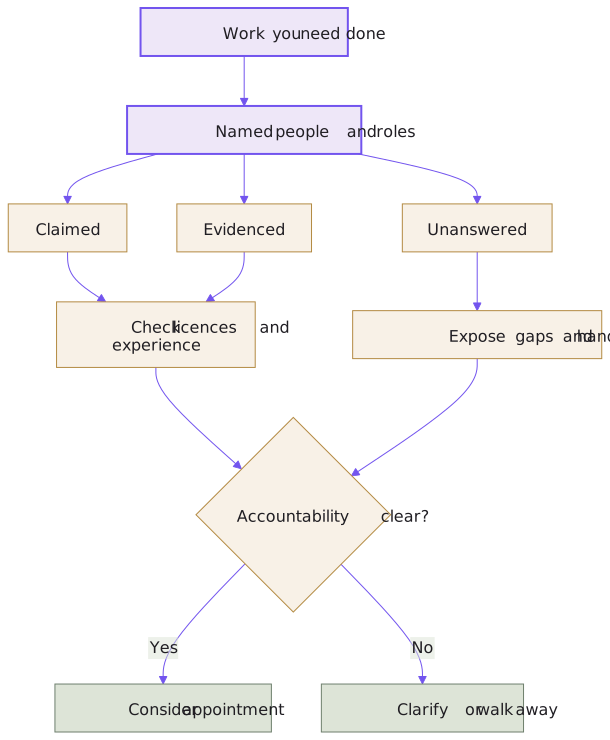
- Record every important point as claimed, evidenced or unanswered, including handoffs, continuity and escalation.
- Ask what facts could change the proposed approach before appointing or paying a provider.
Start with the work, then assess the people
An Australia-to-Dubai move can involve separate but connected workstreams covering Australian departure, personal circumstances, business and assets, destination establishment, responsibilities and handoffs.
Do not ask the vague question “Are you qualified to handle my move?” and accept one vague answer. Break the proposed work into parts and ask who is responsible for each one.
Possible headings include:
- advising on your existing Australian business, assets and departure position;
- recommending or explaining a proposed Dubai structure;
- implementing company-establishment steps;
- processing immigration applications;
- coordinating documents and decisions across workstreams; and
- identifying what happens after establishment.
These are comparison headings, not a universal list of required services. Your circumstances may call for different work or different specialists.
Nine questions to ask about the people involved
1. Who will actually do each part of the work?
Ask for names or clearly defined roles. Establish whether the person leading the sales conversation will also perform the work, supervise it or hand it to somebody else.
For each material task, record both the person doing the work and the person accountable for delivery.
2. What experience is relevant to this specific task?
“International experience” is too broad to assess. Ask what experience is relevant to the jurisdiction, type of business, proposed activity and workstream in question.
Treat the answer as a claim to investigate, not proof by itself. Do not request private client information. A provider can explain relevant experience without disclosing confidential details.
3. What professional scope are you working within?
Ask the person to describe what they are able to advise on, what they only implement and what sits outside their role.
Clear limits are useful. A person who identifies where their scope ends may make it easier to see where a separately qualified specialist is needed.
4. Can the claimed credential be checked independently?
If a person relies on a professional credential, registration or affiliation, ask for the exact name, issuing body and identifying details needed to check it. When an applicable public register or official body exists, verify the claim there yourself.
A verified credential establishes only what the relevant body says it establishes. It does not guarantee service quality, suitability or a particular outcome.
5. How do you handle questions outside your jurisdiction or expertise?
Look for a practical answer: who identifies the gap, how another adviser is introduced or appointed, what information is transferred and who checks that the issue has not been lost between parties.
Do not assume that “we have a network” means a named person has accepted responsibility.
6. Can you demonstrate the process or a sample deliverable?
Ask for a blank template, redacted example or live walkthrough that does not expose private client data. The aim is to see how the provider records decisions, assumptions, exclusions, deadlines and unresolved questions.
A demonstration is evidence of how a process or document looks. It is not evidence that every engagement will run the same way or achieve the same result.
7. How do you explain uncertainty?
Ask what facts could change the proposed approach and which answers cannot be settled until further information is obtained.
Be cautious when a complex, fact-dependent question receives certainty without an explanation of assumptions or limits. A useful answer should help you see what is known, what is conditional and what still requires specialist input.
8. What happens if the assigned person becomes unavailable?
Ask who holds the file, where decisions are recorded, who can continue the work and how an urgent issue is escalated.
Continuity matters because a package may involve several stages and people. The relevant question is not merely whether the business has a team; it is whether responsibility can be transferred without losing context.
9. Who remains responsible for delivery and handoffs?
For every handoff, identify:
- who starts it;
- what must be supplied;
- who receives it;
- who follows up; and
- who confirms completion.
Coordination is one part of assessing delivery. It does not replace checking the competence and scope of each person doing substantive work.
Use a claimed–evidenced–unanswered worksheet
Complete this proposed due-diligence worksheet during provider interviews. Add rows for the tasks that matter to your move.
| Question | What was claimed? | What evidence did I check? | What remains unanswered? |
|---|---|---|---|
| Who will perform each material task? | Written role allocation or named contact | ||
| What relevant jurisdiction and task experience do they claim? | Specific explanation that can be assessed without private client data | ||
| What is inside and outside their professional scope? | Written scope and exclusions | ||
| Is a relied-upon credential independently checkable? | Applicable official register or issuing body | ||
| How are outside-scope questions handled? | Named process, role or referral path | ||
| What does the working process produce? | Blank template, redacted example or demonstration | ||
| Who provides continuity and escalation? | Written backup and escalation process | ||
| Who owns delivery and each handoff? | Responsibility and handoff record |
The worksheet is an editorial decision aid, not a prescribed professional-verification process. Some evidence will not be public, and not every role will have a public credential to check. Record “not applicable” only after understanding why; otherwise leave the point unanswered.
Keep presentation separate from verification
A professional website, confident explanation, testimonial or polished proposal may help you understand how a provider presents its service. None independently proves that a particular person has the relevant competence, authority or scope for your task.
Likewise, a licence, registration or membership, where one applies, should not be treated as a guarantee of quality. Check what the credential covers, whether it belongs to the person or entity you will rely on and whether it is current through the relevant source.
The practical distinction is simple:
- Claimed: the provider or person said it.
- Evidenced: you inspected relevant supporting material or checked an applicable independent source.
- Unanswered: the available material did not settle the question.
An unanswered question is not proof of a problem. It is a reason to seek clarification before relying on the claim.
Ask what would make the provider change its proposed approach
Our guide distinguishes a founder’s personal relocation from the separate review of entities and actual business decision-making.
Use that distinction to test the quality of a provider’s reasoning. Give a simple, expressly hypothetical scenario: the owner intends to live in Dubai, Australian staff and premises remain, and several management responsibilities are unresolved.
Ask the provider:
- What further facts would you need before proposing your part of the work?
- Which assumptions could change the implementation you recommend?
- What can you assess within your role, and what must go to a separately qualified adviser?
- How would those unresolved questions appear in your working documents?
You are looking for a clear account of dependencies and limits, not asking the provider to deliver a complete personal strategy during an interview. A useful response should identify what cannot yet be concluded and explain how the missing information would be obtained.
Record the answer in the claimed–evidenced–unanswered worksheet. If the response jumps straight to incorporation steps, ask which planning questions it assumes have already been resolved.
This is a proposed interview exercise, not a test that certifies competence. It helps you examine whether the provider can connect the work it sells with the particular problem you need to solve.
What you should know before appointing anyone
Before committing, you should be able to identify:
- the person or role doing each material task;
- the jurisdiction and professional scope relevant to that work;
- which important claims you have independently checked;
- which questions remain open;
- how limits and uncertainty will be communicated;
- what the process or deliverable will look like;
- who provides continuity and escalation; and
- who owns delivery when work passes between people.
The aim is not to find somebody who claims to do everything. It is to understand exactly whose judgement and execution you will rely on and what evidence supports that reliance.
Important: This article is general information only and does not constitute legal, tax, financial, investment or immigration advice. Rules and programmes can change. Obtain advice from appropriately qualified professionals who understand your facts and the relevant jurisdictions before acting.