

No. A UAE visa and your Australian tax residency answer different questions. A visa concerns permission to live in another country; it does not, by itself, determine your tax residence.
Likewise, becoming a tax resident elsewhere does not automatically end Australian tax residency. For an Australian founder or business owner, the practical task is not simply to “get the visa”. It is to understand how the facts of the move affect each separate question.
This article provides general information, not tax, legal or immigration advice. Residency outcomes depend on individual circumstances and current law, so obtain advice from appropriately qualified professionals before acting.
At a glance
Key takeaways
- A UAE visa answers whether you can live in the UAE; it does not decide whether Australia still treats you as a tax resident.
- Australian tax residency depends on the wider factual picture, and no single domestic detail or document decides it alone.
- Use ordinary questions, including where your household and everyday belongings are based, to describe where life actually happens.
- Match every visa, housing, travel, tax and business record to the specific fact it supports before seeking qualified advice.
The two questions you need to separate
1. Do I have permission to live in the UAE?
This is an immigration question. Your visa or residence permission addresses whether you can live in the UAE under the relevant conditions.
It does not answer whether Australia still treats you as an Australian tax resident.
2. Am I still an Australian tax resident?
This is a separate tax question. The assessment can consider your physical presence, intentions, behaviour, family and business ties, assets and living arrangements. No single factor from that list necessarily decides the outcome on its own.
One ordinary question makes that principle easier to understand: where is your washing machine? It is not a legal test and it does not decide residency. It can lead to better factual questions. Where do you routinely wash your clothes? Where are your everyday belongings? Where are your partner, children or pets? Which home do you repeatedly return to?
Small domestic details can help show where ordinary life actually happens. Their value lies in the wider pattern, not in any single answer.
That is why a residence visa, flight out of Australia or overseas address should not be treated as a complete Australian exit plan. Leaving Australia does not automatically resolve your tax residency. ATO: your tax residency
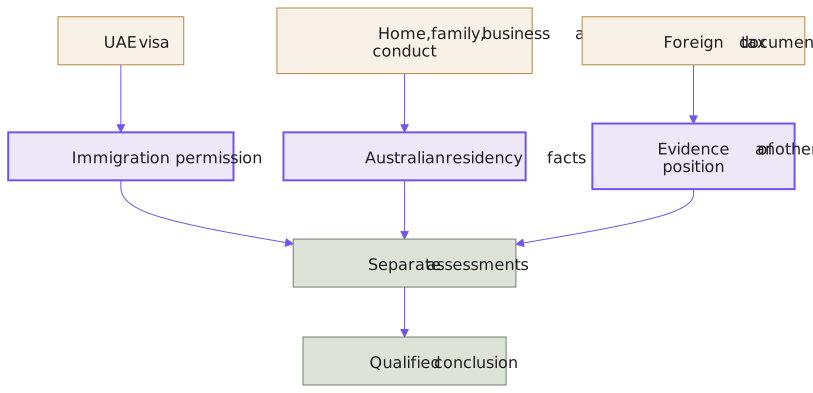
Match each document to the question it can support
A recurring distinction in our guide is between the arrangements that actually exist and the documents that record them; accumulating paperwork is not a substitute for the underlying facts.
Apply that distinction whenever a document is described as “proof of residency”. Ask what specific proposition it supports and what still needs separate assessment.
| Document or record | What to examine | What remains a separate question? |
|---|---|---|
| Visa or residence permission | The permission and its conditions | Your Australian tax-residency position |
| Overseas housing records | The accommodation arranged and how it is actually used | The significance of those arrangements within the whole factual picture |
| Travel records | Dates, destinations and the reasons for travel | How the pattern relates to where ordinary life and work occur |
| Tax residency certificate | The status and period the issuing authority addresses | Its relevance to other jurisdictions and the underlying Australian facts |
| Business records | Where work and decisions actually happen | The treatment of the relevant person and entities |
This is an evidence-reading exercise, not a checklist that produces a residency outcome. Ask the appropriate immigration or tax professional to assess the question within their scope.
Consider an explicitly hypothetical mismatch: a plan says a person will live in Dubai, while their actual calendar still centres on their Australian home and regular work there. Adding another document does not explain that difference. The useful next step is to describe the real arrangements accurately and have their significance assessed.
Do not alter facts to fit the preferred answer. If the plan and reality differ, bring the difference into the advice conversation. A certificate may be evidence, but it cannot override the underlying facts.
What to prepare before seeking advice
You do not need to decide your own residency status before speaking with an adviser. You do need to give them a clear account of the proposed move.
Prepare a short fact file covering:
- why you are considering leaving Australia;
- your proposed departure and travel pattern;
- where you and your immediate family expect to live;
- what will happen to your Australian home or other accommodation;
- where you will perform and manage your work;
- how your business will operate after the move;
- which assets, accounts and ongoing commitments you expect to retain in Australia;
- which parts of the plan are fixed and which remain optional; and
- any advice already received, including the assumptions behind it.
These details matter because residency can depend on conduct and living arrangements as well as stated intention. If the plan changes, ask whether the earlier advice still holds.
When to delay a commitment
Consider pausing an irreversible step if:
- you have a visa pathway but no considered answer on Australian tax residency;
- your advisers are working from different assumptions about where you will live or run the business;
- your family, housing or business arrangements are still changing materially;
- you are relying on one document or one headline rule to settle the entire issue; or
- nobody has clearly explained which professional owns each unanswered question.
Delay can be the sensible choice. It gives you time to align the immigration, tax, business and personal parts of the move before signing long contracts, restructuring a business or disposing of assets.
The key answer
A UAE visa can be an important part of a move, but it does not settle your Australian tax residency. The useful next step is to separate immigration permission from tax residency, document the facts of your proposed move and obtain advice that addresses your circumstances.
If you still need the foundations, the Australian Exit Guide is an educational resource for entrepreneurs considering leaving Australia or restructuring. Australian Exit Guide For a conclusion about your own position, discuss the complete facts with an appropriately qualified adviser.
Important: This article is general information only and does not constitute legal, tax, financial, investment or immigration advice. Rules and programmes can change. Obtain advice from appropriately qualified professionals who understand your facts and the relevant jurisdictions before acting.